
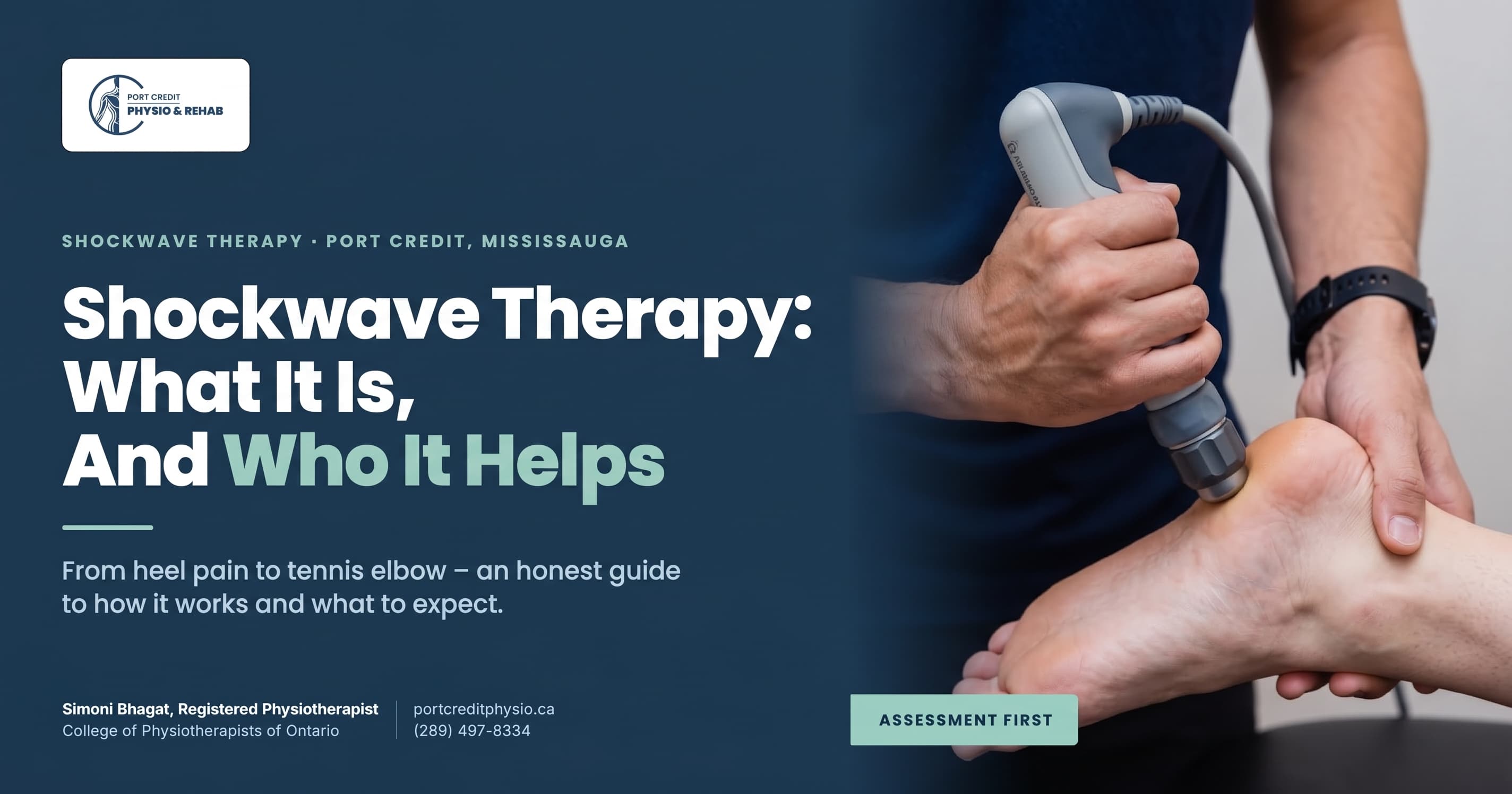
If you have been dealing with heel pain, tennis elbow, or a tendon injury that just will not settle down, you may have come across shockwave therapy, also called Extracorporeal Shockwave Therapy, or ESWT, while looking for relief. Here is a clear, jargon-free guide to what it is, who it tends to help, and what treatment actually looks like at Port Credit Physio & Rehab.
What Is Shockwave Therapy?
Shockwave therapy uses a handheld device to deliver quick pulses of sound energy into an injured area, despite the name, no electricity enters your body. These pulses create a controlled amount of mechanical stress in the tissue, which is thought to:
- Increase blood flow to the area, bringing more oxygen and nutrients to tissue that is healing slowly
- Reduce pain signals, in a way similar to how a TENS machine can dull pain by "distracting" the nervous system
- Prompt the body's healing response in tissue that has become stuck in a chronic, non-healing state
- Assist in breaking down calcium deposits, particularly in some shoulder injuries
There are two main types of devices, focused shockwave, which targets deeper tissue, and radial shockwave, which spreads energy over a broader, shallower area. Your physiotherapist chooses the type and settings based on your specific injury.
What Does It Actually Help With?
Shockwave is generally used for chronic injuries, ones that have been present for three months or longer, rather than something injured last week. Common conditions include:
- Plantar fasciitis (heel pain)
- Tennis elbow and golfer's elbow
- Achilles tendon pain
- Shoulder pain, especially from calcium buildup (calcific tendinopathy)
- Patellar tendinopathy ("jumper's knee")
- Chronic muscle knots and trigger points
- IT band syndrome and bursitis
Not sure if your shoulder pain is calcific tendinopathy rather than frozen shoulder? The two can feel similar but need very different treatment, a hands-on assessment is the reliable way to tell them apart.
Does the Research Actually Support It?
This is worth being honest about, because a lot of marketing overstates it. The evidence is genuinely stronger for some conditions than others:
- Calcific tendinopathy of the shoulder and tennis elbow have some of the more consistent supporting research.
- Plantar fasciitis: the condition shockwave is most commonly advertised for, has mixed results in studies. Some research shows it outperforms a placebo treatment; other studies have not found a clear advantage over simpler options like stretching. It is often still worth trying after basic conservative treatment has not worked, but it is not a guaranteed fix.
- Patellar tendinopathy (jumper's knee) also has mixed evidence, several studies found no extra benefit compared to a well-structured exercise program alone.
Across almost every condition it is used for, one thing is consistent: shockwave works best paired with the right exercises, not as a stand-alone treatment. We will not promise a specific success rate, we will tell you honestly, based on your specific injury, whether it is a reasonable option worth trying.
Is It Right for You?
Shockwave may be worth considering if:
- Your pain has lasted for several months, not days
- You have already tried rest, stretching, or a basic exercise program without full relief
- You are hoping to avoid injections or surgery, if possible
It is generally not used if you are pregnant, have an active infection or open wound near the treatment area, have a pacemaker or other implanted device nearby, or have certain blood-clotting conditions or are on blood thinners. Your physiotherapist will review your history before recommending it.
What Happens During Treatment?
- Assessment first: We examine your injury and confirm shockwave is genuinely a good fit before recommending it, not every injury needs it.
- A short session: A gel is applied, and the device delivers pulses to the sore area for a few minutes. It can feel like a deep ache, especially in the first session, but we adjust the intensity to keep it tolerable, we do not use numbing cream beforehand, since that can interfere with the treatment's effect.
- A few visits: Most people need 3 to 5 sessions, spaced one to two weeks apart. Do not expect much change after the first visit, improvement usually builds gradually over several weeks.
- Exercises alongside it: We typically provide a specific exercise program to do between sessions, since combining the two produces better results than shockwave alone.
- Tracking your progress: We check in on how you are responding throughout your treatment course, rather than running a fixed number of sessions regardless of how you are doing.
Is It Safe?
Yes, for most people. Side effects are usually mild and temporary, some redness, minor swelling, bruising, or soreness after treatment. Serious complications are rare when treatment is delivered by a trained clinician who has properly assessed the injury first.
Seek prompt medical attention rather than booking shockwave therapy if you have signs of an acute fracture, an active infection at the site, or new numbness, significant swelling, or deformity that has not been assessed.
Why Port Credit Physio & Rehab
We are on Lakeshore Road East in Port Credit, serving patients from across Mississauga, Clarkson, Lorne Park, Cooksville, Erindale and beyond.
- Registered and regulated: Treatment with physiotherapists registered with the College of Physiotherapists of Ontario
- No referral needed: Book directly
- Honest assessment first: We will tell you if shockwave is not the right fit rather than recommending it by default
- Direct billing: To most major insurers, plus MVA and WSIB claims. Coverage varies by plan, and we will verify your benefits before you commit
- Free 2-hour parking: Lot 7 and Lot 12 nearby, plus street parking in front

About Simoni Bhagat
Registered Physiotherapist
Simoni Bhagat is a Registered Physiotherapist and the owner of Port Credit Physio & Rehab, practising in good standing with the College of Physiotherapists of Ontario (CPO) since 2021. Guided by her philosophy of Restore, Rebuild, and Reclaim, she combines evidence-based physiotherapy, personalized exercise programs, and patient education to treat the root cause of pain rather than just the symptoms.
Frequently Asked Questions
Does it hurt?
It can feel like a deep, dull ache rather than sharp pain, and usually feels less intense as sessions go on.
How soon will I feel better?
Some people notice improvement within a couple of sessions; for most, meaningful change builds over four to six weeks.
Is it covered by insurance?
It is typically billed as part of a physiotherapy visit. Coverage varies by plan, so check with your extended health provider or ask us for help confirming.
Is it guaranteed to work?
No treatment is, and we will be upfront if we do not think it is a good fit for your specific injury rather than recommending it by default.
Do I need a doctor's referral for physiotherapy in Ontario?
No. You can book directly with a physiotherapist in Ontario. Some extended health plans require a referral before they will reimburse, so check your policy.
Ready to Get Assessed?
At Port Credit Physio & Rehab, we will give you an honest assessment of whether shockwave therapy is likely to help your specific injury, not a one-size-fits-all sales pitch. We proudly serve patients throughout Port Credit, Clarkson, and Mississauga.
Book Your Assessment