
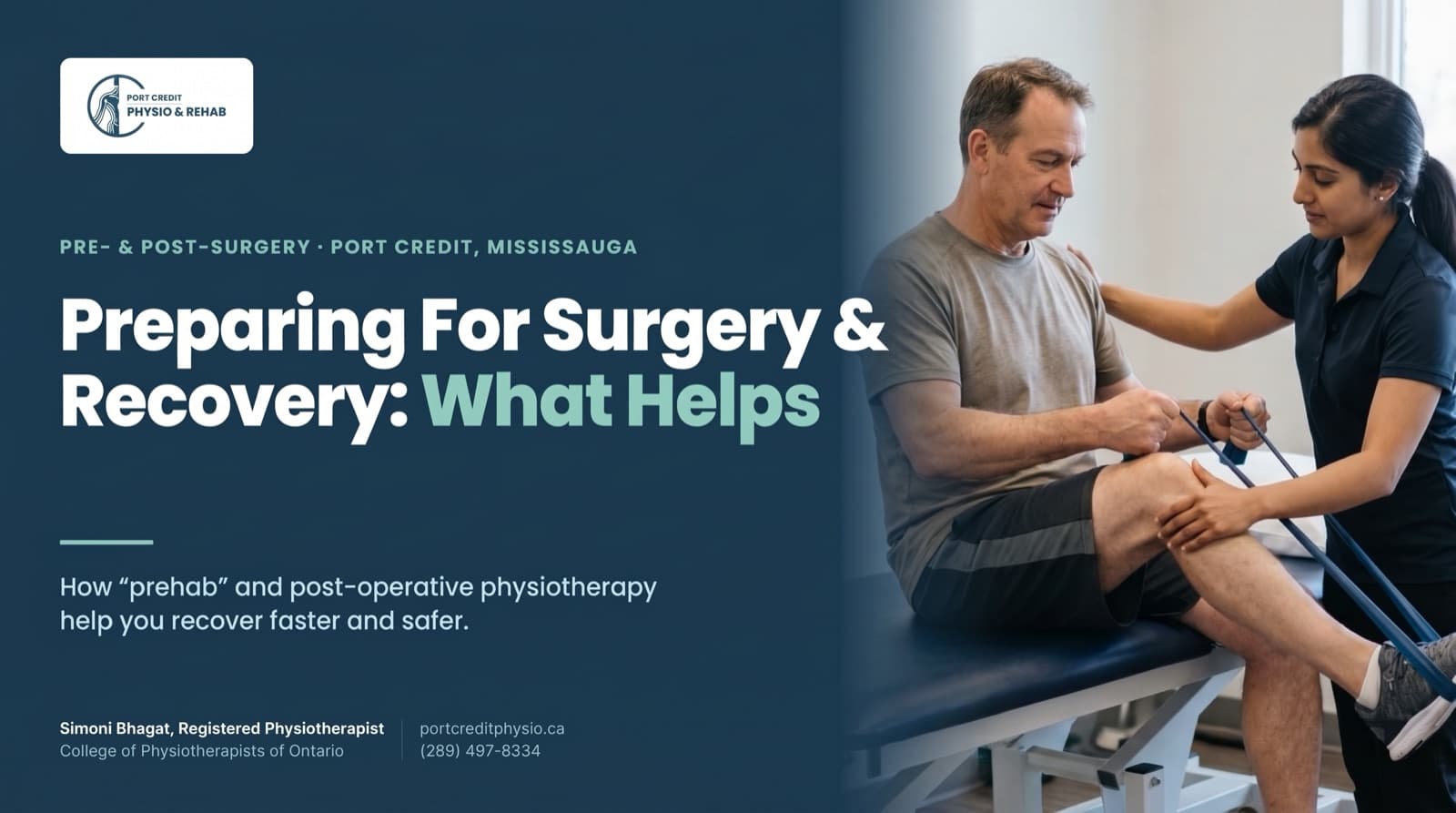
Physiotherapy before and after surgery helps you recover faster, more safely, and more completely. Before surgery, prehab builds strength, mobility, and confidence so you start recovery from a higher baseline. After surgery, a physiotherapist guides you through staged loading to control swelling, restore movement, and rebuild strength. Physio can't speed up tissue healing, but it makes sure that healing turns into real function.
Surgery fixes the structure: the torn ligament, the worn joint, the damaged tendon. Your muscles, joints, and nervous system still have to learn to use that repair. As Registered Physiotherapists in Port Credit, Mississauga, that's the part of recovery we help patients with every day through our pre- and post-surgical physiotherapy program.
What Is Prehab Before Surgery?
Prehabilitation, or prehab, is a targeted exercise and education program in the weeks before your operation. Think of it as training for an event. Surgery is a planned injury, and the stronger your body is going in, the more reserve you have coming out.
A prehab program typically focuses on:
- Strengthening the muscles that shut down after surgery: after knee surgery, the quadriceps often "switch off" because swelling sends inhibiting signals from the joint. A stronger quad beforehand gives you more to work with.
- Maximizing range of motion: patients who arrive at surgery with a stiff joint often find it harder to regain motion afterward.
- Rehearsing early recovery: you practise crutches, stairs, and getting out of bed before you're sore and tired.
- Setting expectations: knowing what week two should feel like reduces anxiety and helps you spot problems early.
Does Physiotherapy Before Surgery Actually Help?
For many people, yes, though the benefit depends on the procedure and your starting fitness. Research on prehab for joint replacement and ACL reconstruction generally shows better early strength and function, and patients often feel more confident at discharge. People who are deconditioned or very stiff before surgery tend to gain the most.
Prehab doesn't change the surgical result itself. It changes how quickly you can get up, move, and start rehab properly. Even 4 to 6 weeks of focused work can make a clear difference.
Post-Operative Rehabilitation: How Physiotherapy Helps After Surgery
Good post-operative rehabilitation follows the biology of healing. Tissues move through predictable stages: inflammation, repair, and remodelling. Loading too early risks damaging the repair, while loading too late leads to stiffness, weakness, and restrictive scar tissue.
Here's how recovery typically unfolds. Timelines vary by surgery, and a good physiotherapist always works within your surgeon's protocol.
| Phase | Typical Timing | Main Goals | What Your Physiotherapist Does |
|---|---|---|---|
| 1. Protect | Week 0–2 | Control pain and swelling, protect the repair | Gait aid training, swelling management, gentle mobility, muscle activation |
| 2. Restore Motion | Week 2–6 | Regain range of motion, normalize walking | Manual therapy, progressive mobility work, early strengthening |
| 3. Rebuild Strength | Week 6–12 | Build strength, balance, and endurance | Progressive resistance training, balance and control drills |
| 4. Return to Function | 3+ months | Return to work, sport, and hobbies | Task-specific training, return-to-activity testing |
Why the First Six Weeks Matter Most
The early weeks set the ceiling for the rest of your recovery. After a knee replacement, getting the knee fully straight early is critical. A knee that stays slightly bent changes how you walk and loads the joint unevenly for years.
Scar tissue also matures over time. Motion gained in the first two months comes far more easily than motion you chase at month six.
How Soon After Surgery Should You Start Physiotherapy?
For most orthopedic surgeries, you'll start moving within 24 hours, often while still in hospital. Outpatient physiotherapy usually begins within 1 to 2 weeks of discharge. Some procedures, such as rotator cuff repairs, need a longer protected period in a sling before active exercise begins.
Your surgeon's instructions always come first, so bring them to your first appointment. If travelling to a clinic feels hard in the first few weeks, we also offer in-home physiotherapy after surgery across Port Credit and nearby neighbourhoods.
What Physiotherapy Can't Do (An Honest Look)
Realistic expectations help you plan and stop you from blaming yourself when progress feels slow.
- Physio can't speed up tissue healing: a tendon repaired to bone needs roughly 12 weeks or more to become strong. We protect your strength and mobility while that happens.
- Physio can't fix a surgical complication: if something structural seems wrong, we'll recognize it and refer you back to your surgeon.
- Physio can't do the work for you: most recovery happens in your home exercises. Clinic visits are the coaching; daily practice is the training.
- Recovery isn't a straight line: a sore day after a harder session is normal. A steady decline is not.
Pre-Surgery Preparation Checklist
Use this checklist in the 4 to 6 weeks before your operation:
- Book a prehab assessment with a Registered Physiotherapist
- Complete a daily strength and mobility program
- Practise walking with your crutches, cane, or walker
- Remove trip hazards at home, such as loose rugs and cords
- Set up a main-floor rest area if stairs will be hard
- Arrange rides, since most people can't drive for several weeks
- Prepare ice packs and loose, easy-to-wear clothing
- Ask your surgeon for your post-op protocol and restrictions
- Book your first post-op physio appointment before surgery day
Want a plan built around your surgery? Learn more about our pre- and post-surgical physiotherapy in Mississauga, or book a prehab assessment online.
How Long Does Recovery Take After Surgery?
Recovery after surgery varies widely. As a general guide:
- Knee arthroscopy (meniscus trim): 4 to 8 weeks to normal daily function
- Total hip replacement: 6 to 12 weeks for daily activities, up to a year for full strength
- Total knee replacement: 3 to 6 months for most function, up to a year for full recovery
- ACL reconstruction: 9 to 12 months before returning to cutting and pivoting sports
- Rotator cuff repair: 4 to 6 months, with full strength often taking up to a year
Your timeline also depends on age, fitness before surgery, health conditions such as diabetes, smoking, and how consistently you follow your home program. That last factor is the one you control most.
Planning a return to sport after surgery? Read more about our sports injury physiotherapy.
When to Seek Immediate Help: Post-Surgery Red Flags
Most discomfort after surgery is expected. Some symptoms are not.
Call 911 or go to the nearest emergency department if you have sudden shortness of breath or chest pain (which can signal a blood clot in the lungs), are coughing up blood, or have sudden confusion, slurred speech, or facial drooping.
Contact your surgeon or family doctor the same day if you notice:
- Calf pain, swelling, warmth, or redness in one leg, which are possible signs of a deep vein thrombosis (DVT)
- A fever above 38°C, or chills
- Spreading redness, pus, a bad smell, or an opening incision
- Pain that keeps getting worse instead of gradually easing
- New numbness, tingling, or weakness in your arm or leg
- A sudden "pop," giving way, or loss of motion you had already regained
Your physiotherapist screens for these signs at every visit. If we're concerned, we'll tell you directly and help you reach the right care quickly.
What to Expect at Your First Physiotherapy Visit
Your first appointment is a full assessment. We review your surgery, your surgeon's protocol, and your goals, then measure your range of motion, strength, swelling, and walking pattern.
You'll leave with a clear plan: what to do at home, how often, and what progress should look like over the coming weeks. Many patients also benefit from massage therapy to ease muscle tension in the neck, hips, or back caused by limping and compensating.
Start Your Recovery Before Surgery Day
The best surgical outcomes rarely happen by accident. They come from preparing early, following a plan matched to your healing, and having an expert guide who knows what "normal" should look like.
Whether your surgery is weeks away or you've just come home from hospital, our Registered Physiotherapists in Port Credit, Mississauga, can help, in clinic or in your home. Explore our pre- and post-surgical physiotherapy services to see how we support your recovery.
👉 Book your pre- or post-surgery physiotherapy assessment online. Not sure where to start? Book a free 15-minute consultation and we'll help you plan your next step.

About Simoni Bhagat
Registered Physiotherapist
Simoni Bhagat is a Registered Physiotherapist and the owner of Port Credit Physio & Rehab, practising in good standing with the College of Physiotherapists of Ontario (CPO) since 2021. She guides patients through prehab and post-operative rehabilitation for joint replacements, ACL reconstructions, rotator cuff repairs, and more, both in clinic and in patients' homes across Port Credit and Mississauga. Guided by her philosophy of Restore, Rebuild, and Reclaim, she combines evidence-based physiotherapy, personalized exercise programs, and patient education to help every patient recover with confidence.
Frequently Asked Questions
Can I do prehab exercises at home?
Yes. Most prehab is done at home after an initial assessment. Your physiotherapist chooses exercises that are safe for your joint and condition, then checks and progresses them at follow-up visits.
How often should I see a physiotherapist after surgery?
Most patients start with one to two visits per week in the early phases. Visits usually become less frequent as you gain independence with your home program.
Is it normal to have pain during physiotherapy after surgery?
Mild to moderate discomfort during and after exercises is normal and usually settles within a few hours. Sharp pain, or pain that keeps getting worse, should be reported to your physiotherapist or surgeon.
How soon after surgery should I start physiotherapy?
For most orthopedic surgeries you will start moving within 24 hours, often in hospital, and outpatient physiotherapy usually begins within 1 to 2 weeks of discharge. Some procedures, such as rotator cuff repairs, need a longer protected period first. Always follow your surgeon's protocol.
Do you offer physiotherapy at home after surgery?
Yes. If travelling to the clinic is difficult in the first few weeks after surgery, our Registered Physiotherapists offer in-home physiotherapy across Port Credit and nearby Mississauga neighbourhoods.
Book Your Pre- or Post-Surgery Physiotherapy Assessment
Whether your surgery is weeks away or you've just come home from hospital, our Registered Physiotherapists in Port Credit will build a plan around your surgeon's protocol, in clinic or in your home.
Book Your Assessment Online